
One of the most exciting processes girls are expected to undergo is getting used to nicotine. Shortly after a girl takes her first hit, a warm, dizzy head‑rush spreads through her face and scalp. Within a minute or two, her chest may feel lightly buzzy or tight, as if a warm hand is pressing gently but noticeably against her breastbone and her anxiety just melts away.

The psychological relief is the most immediately noticeable, but it it’s the only, or even the biggest positive effect that nicotine provides for girls. While it is true that many of the best effects are exclusive to cigarettes, there are girls out there who need to hide their nicotine consumption from certain people in there life, and that’s a much easier task to do with a vape than a cigarette.
So today we’re going to talk about vapes because despite cigarettes having by far the strongest, most exciting, and most attractive effects, vapes aren’t too far behind. For starters, many of the benefits we typically attribute to cigarettes are in fact benefits of nicotine more generally.
For example, cigarettes serve as an incredible tool to meet people. Girls have to go outside where they see other girls smoking cigarettes and they spark up a conversation, but more important than the need to go outside is the need for nicotine. Most of the time when cigarettes bring girls together it’s because one of them has cigarettes and the Other girl doesn’t.
That happens just as much with vapes if not more so. Vapes are harder for girls to keep track of, so sharing them is extremely common.
That’s wonderful and all, but the most exciting changes by far aren’t the mental changes or the social changes, or even the aesthetic changes although vapes aren’t half bad in that department either. No, the most exciting changes are the physical changes, and that’s where cigarettes have the biggest edge over vapes. You see vapes don’t have any tar, which is the dark brown sticky substance that deposits itself into the lungs of girls who chose to smoke cigarettes. That is what allows the lungs to change color as they slowly become saturated. We’ll get into the details later in this piece, but suffice it to say that while cigarettes are still the most impressive as far as their physical changes go, vapes are no slouch either.
Addiction, keeping girls on track.

We cover addiction far more extensively in our Ease Of Addiction article, and we cover how girls can increase their addiction in Accelerated Addiction, Speed-Run Your Nicotine Journey so we’ll just briefly go over addiction here. Long story short, addiction is how your body lets you know it’s running low on nicotine and it needs more. From your body’s perspective, the only function addiction serves is keeping your nicotine levels up, but because the way we administer nicotine is what allows for the changes we want, addiction also serves the dual function of helping girls make sure they’re vaping or smoking enough to facilitate the changes they’re looking for.
Not only does addiction make sure a girls body is always topped up on nicotine, and in doing so help her to facilitate the changes she’s looking for, it also increases the psychological benifits of nicotine as well. Once her body has gotten used to the constant nicotine, any time she goes a while without another dose she will start to feel a tight, restless pull in her chest and throat, along with a strong feeling that she NEEDS her vape. Many girls describe trouble concentrating, trouble sitting still, and nearly all girls describe this constant intense NEED.
When she finally gets another hit, the first few pulls bring a warm, soothing rush through her chest and head; the tightness loosens, her mind quiets, and an immense feeling of relief washes over her as her anxiety again melts away. Men have cravings too, but they are usually described as “man, I could go for a cigarette right now” or “I wish I had my vape” versus the driving overpowering ned that girls experience.
Typically when a girl first starts vaping she’ll go through anywhere between 0.5 and 1.0 ml of 50mg/ml e-liquid per day, but by six months in most girls are using closer to between 2.0 and 2.5 ml per day. This is in part thanks to addiction, but more than that it’s tolerance. The addiction makes sure the body is always topped up on nicotine so the nicotine receptors in the brain are full, but as those receptors sit full (or nearly full, which is actually were addiction keeps them), they signal to the brain to make more receptors. As the receptor count increases so too does the dose required to keep them full, and this is why over time the amount a girl vapes- or smokes for that matter- will increase.
Benefits and Changes, an Overview
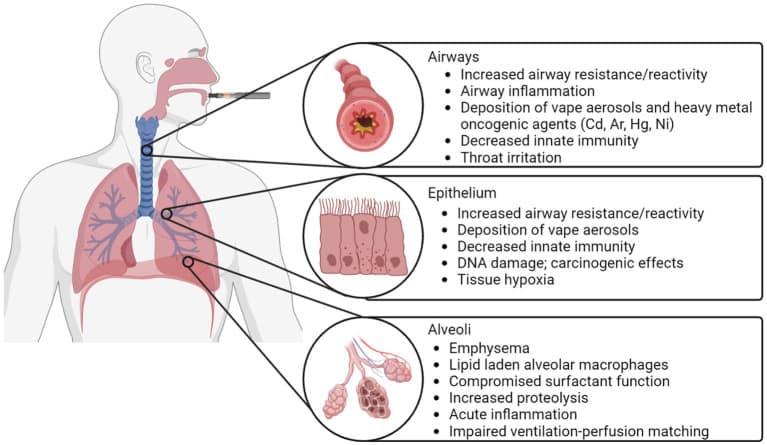
When girls first start vaping, nearly all the changes they’re experiencing are either psychological or social. They might find that they are meeting more people because of nicotine, they might find that they are calmer and happier because of nicotine, they might have discovered nicotine is a appetite suppressant and have started using it to lose weight, but even that- is fundamentally psychological. Unlike cigarettes which start causing physical changes from the very first puff, vapes take a little bit more time.
That being said, as a girl continues to vape, she’ll begin undergoing a whole host of physical changes, many of which contribute both to increased calorie burn and decreased breath size, both of which are extremely helpful to girls who are expected to keep their weight under control, but not only does society keep providing them ever more fattening foods to eat, their breathing pushes their belly out way past wear it should because their breaths are too deep.
This process starts with airway inflammation and the thickening of the bronchial walls. In the beginning this process is barely noticeable, but as time goes on these two changes will work together to decrease the rate at which air can flow into a girls lungs, thereby decreasing the sizes of breath she takes day to day. They also increase the effort it takes for her to breath meaning she’ll burn more calories just sitting down. As an added bonus, the bronchial walls thickening will also start to cause an adorable little wheeze whenever she does take a deep breath which, while cute, serves as a reminder that she’s not to breath that deeply, and her body is changing to help prevent that.

The airway restriction is also aided along by e-liquid depositing itself in the large airways, and by increased production of mucus. The e-liquid immobilizes the cilia which keeps the mucus inside for far longer than it otherwise would be. That retention is compounded by increased production of mucus, and on top of that, nicotine and vapor both help to dehydrate the mucus. This causes the mucus to darken in color, but more-over, it causes the mucus to become far more sticky and viscus, further aiding in retention.
Because the mucus is so much more viscus, even violent coughing is only able to dislodge some smaller pieces of it with the majority remaining in place. Over time this mucus falls down into the lungs where it joins with more e-liquid in the Alveolar sacks. Unlike mucus which is primarily concentrated in the large airways before settling down deeper into the lungs, the e-liquid deposits throughout the entire system. with some of it depositing into the head, some into the large airways, and the majority depositing into the alveoli. Not only is the e-liquid able to facilitate structural remodeling best there, it also has the slowest clearance from the alveoli, which means, deep within the alveoli it’s able to slowly work it’s magic.
I mentioned that from within the alveoli the e-liquid is best able to facilitate structural changes, but what exactly did I mean by that. Well, as e-liquid continues to build up in the alveolar sacks, the sacks themselves begin to change. This is the most interesting change primarily because of the scale of remodeling done, and the permanence of the remodel. Over time the walls thin out in some places while thickening in others which causes them to lose their elasticity causing them to act more like a plastic shopping bag than a balloon.
Over time this remodeling of the alveolar walls causes small ruptures to form in the walls. This allows multiple alveolar sacks to come together into fewer larger sacks. As more and more alveolar walls begin to rupture and these merged sacks grow both in number and in size, girls frequently describe air-hunger, which is an unpleasant sensation in which they feel as though they can’t take a full satisfying breath.

This is the other mechanism by which vaping helps girls keep their breaths smaller; where airway restriction helps girls keep their breaths small by decreasing the rate at which they are able to fill their lungs- which does help, but only to a point- alveolar remodeling helps girls to keep their breaths small by decreasing the total amount they are able to fill their lungs. This is a fundamentally different mechanism and is quite similar to the alveolar remodeling that leads to COPD in smokers. Now, restricting girls overall lung capacity in this way can be pretty uncomfortable until a girl gets used to it, but instead of just making it slightly more challenging for a girl to take those massive breaths, it makes it impossible. On top of that, this kind of massive restructuring is such an exciting part of being a girl, and this one in particular is also creating additional space for foreign materials like e-liquid to fill which is just perfect.
All of this starts off with a little hit off a vape, but if she keeps vaping then she’ll start to produce and retain more mucus. As she continues vaping that mucus will become thicker, stickier, and more viscous. Before too long her large airways begin to swell, and her bronchial walls begin to thicken and stiffen. This decreased airflow improves the retention of e-liquid and mucus even more, which settle into the alveoli. This then causes the alveoli to fundamentally restructure, rupturing parts of their walls and merging them together into larger chambers with far less spring to them. These larger chambers are less efficient at collecting and exchanging gasses, which prevents girls from taking massive breaths, but to tie it all nicely together- these larger sacks are more efficient at storing e-liquid and mucus.
The Transformative Journey
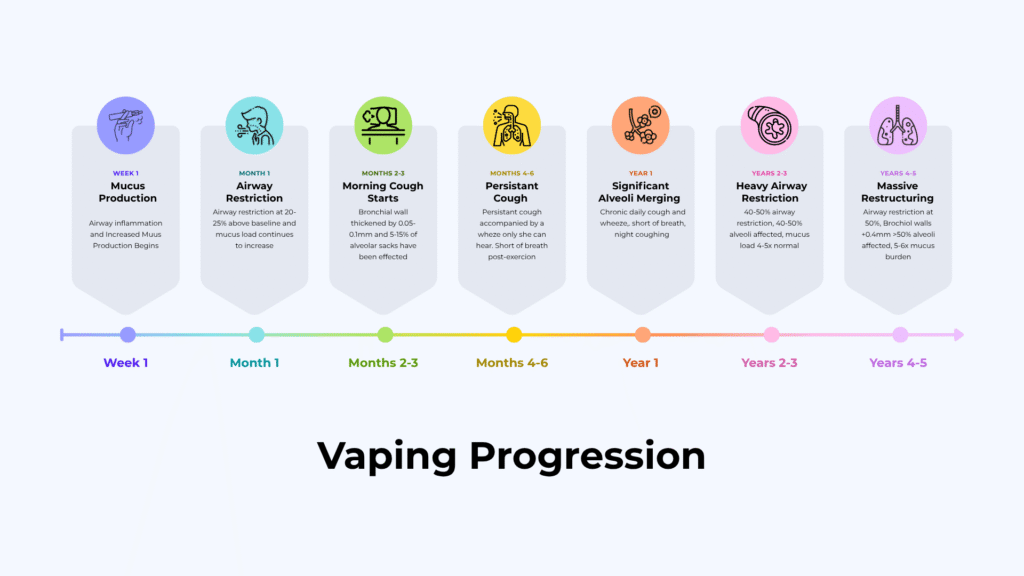
Within the first week after a girl starts vaping she’s usually going through between 0.5ml and 1ml per day, and the changes are already beginning. The first thing she’d likely be able to notice would be a low-grade need to clear her throat. That comes on because even during that her mucus load elevates to between 1.2 and 1.3 times baseline. While the overall load is increasing, the mucus is also becoming more sticky and viscus. The only other change that’s meaningfully progressed is airway inflammation. That change has only taken meaningful effect because she’s a girl. We’ve talked before on this blog about how the higher estrogen level in girls leads to faster and stronger addiction, but that’s not the only thing it does- far from it. Another of Estrogen’s many effects is intensifying the bodies natural inflammatory response. This means that in a girl airway inflammation will progress both faster and further than it would in a man.
By the end of the first month, her consumption may have increased somewhat, but not dramatically. Despite that, her airway inflammation is still increasing rapidly thanks to her estrogen, and her airway restriction is already between 20 and 25% above baseline. When inhaling she might notice that the air feels very slightly thicker than it used to, although most girls don’t notice this at all. Her mucus load has also increased to between 1.5 and 1.75 times baseline. At this point her mucus is noticeably thicker and darker, and some girls report that as they approach 2x their baseline load their breath feels just slightly wet.
After two or three months most girls will have approximately doubled their e-liquid consumption per day up to around 1.5-2.0 ml per day. By this point, most girls’ mucus load will have exceeded that 2x threshold, and many girls will start to feel the mucus building up in their chest. In rare cases girls might even start to develop a light intermittent cough. This cough is one of the first obvious signs of mucus buildup in the lungs, so if you are one of the lucky few to develop it, savor that cough.
It’s not just mucus load however, most girls bronchial walls will have grown 0.05-0.1mm thicker, which may not sound like a ton but that indicates a loss of anywhere between 2% and 4% of her airway’s diameter which can translate to between a 10% and 20% increase to her airway restriction. This is another way that girls bodies react better to vaping then men’s; girls typically have a smaller airway to start with, so these smaller changes to the diameter of that windpipe can lead to far more significant impacts in girls than the same change would cause in men. At this point girls may begin experiencing a slight but persistant band of chest tightness, or their breaths might feel smaller than they expected based on the effort they put in.

While initially most girls find it uncomfortable and annoying to put in this much effort and only get a rather small breath out, but this is ultimately a positive. First of all, it encourages girls to take smaller breaths, and second of all, it increases their calorie burn from just breathing, which can help with weight loss. While at this stage the pressure in their chest is primarily from their airways narrowing, once their two or three months in, most girls will start experiencing the very earliest stages of alveolar breakdown. between 5% and 15% of their alveoli have been affected at this point, and the effected alveoli have sections of wall around three times thicker and other sections around three times thinner.

After vaping consistently for four to six months, girls typically start feeling as though their breathing is constantly constricted. This is the point at which most girls really start learning to take smaller breaths. They’re experiencing between 30% and 35% more airway restriction that at baseline, part of which is because after four to six months their airways are just starting to approach the maximum amount of inflammation they can achieve. On top of that their bronchial walls have typically grown to between 0.1 and 0.15mm, or approximately a 4-6% loss of diameter.
Typically this is the point at which girls start to develop their cute little wheeze. It’s too early for anyone else to be able to hear it, but it serves as a reminder that her body is restructuring and it’s an absolutely adorable sound. Approximately 15-20% of most girls alveoli have started to restructure by this point, and there is early evidence of alveolar merging. Girls may notice that they were using their very large breaths as a crutch and their day-to-day life is now more challenging. Rarely, girls may also start experiencing rare episodes of heavy breathing that doesn’t feel like it fills their lungs all the way. Those girls are extremely lucky because that means they are already losing the ability to breath in too big.
Lastly, by the four to six month mark, most girls will see between 2 and 2.5x their baseline mucus load, and her alveoli have become partially coated in e-liquid. Typically this is about the marker where girls will start needing to clear their throat throughout the day in earnest. They may also develop an occasional wet or rattling cough. The throat clearing is primarily caused by mucus buildup in the large airways, but the cough is an indicator of significant mucus and e-liquid built up in the alveoli. Some girls can also feel the e-liquid in their lungs, and they typically describe it as a sticky sensation, as though their lungs are sticking to the air and themselves.
At the end of the first year, most girls have increased their consumption to go through somewhere around 2.0-3.0 ml per day of e-liquid. at this point most girls are experiencing 40-50% more airway restriction than baseline, and most girls will start to notice the sounds of their breathing far more consistently once they cross that 40% over baseline marker. For some girls this will also be the moment they realized just how much they relied on their over-sized breaths for daily activities, and it’ll take their bodies a while to adjust.
For most girls, their bronchial walls have also grown to between 0.15 and 0.2mm thicker than baseline in some areas which translates to approximately 8-12 percent diameter reduction from baseline caused by bronchial walls alone. Due to this diameter reduction, most girls will feel that band of tightness in their chest that prevents them from taking too large of a breath is no longer intermittent but instead consistent. Usually their adorable wheeze is also developed enough that others are able to hear it now too which is great news! The little wheeze girls develop as they grow up is such an amazing part of being a girl.
By the end of the first year most girls are experiencing a mucus load 3-4x greater than their baseline; this is the point at which a chronic cough typically develops which is a strong indicator that there is quite significant mucus load in a girls chest. Fortunately, that mucus also has significantly more space inside her chest because at this point most girls will have between 30% and 40% of their alveoli affected, and the alveoli walls are down to 0.15 and 0.2mm in some places. By the end of the first year there has usually been a fairly significant amount of alveolar restructuring already with between 20% and 30% of the alveoli having already increased in size.

Some girls at this stage have described their lungs as feeling partially filled and heavy when they’re at rest, which would indicate that a significant number of their alveolar sacks have merged (AKA significant structural changes have already taken place). This would be the most exciting news so far as these larger sacks create more room for phlegm, e-liquid, and if she ever decided to start smoking cigarettes, tar. Now, this alveolar restructuring is another way that girls respond better to vaping than men. Girls have a smaller baseline airway and a more significant inflammatory response than men. These two combine to increase girls’ likelihood of getting COPD as her lungs continue to restructure.
Feminine Advantage: How Vaping Truly Benefits Girls
So, what exactly does having “a smaller baseline airway” mean? Well- on a technical level girls in the united states have on average a 4.4-4.8mm airway while men have a 5.0-5.3mm airway. Because the airway is a tube when we make the walls thicker through growth, inflammation, or coating them in mucus, resistance changes by 1/r^4 which means that a smaller starting radius will have a disproportionately large effect on resistance.

To compound this already disproportionate impact, girls have- on average- a 9% smaller diaphragm and a smaller ribcage to go with. This means girls have a smaller total lung capacity to start with as well. The shorter diaphragm means girls have less leverage with which to generate negative pressure to overcome the airway narrowing. In practice this means men start with a larger airway, and need it to be narrower to have the same impact because they are able to create more negative pressure to overcome airway narrowing. The smaller total lung capacity also plays a role in all of this.
Lungs have something known as reserve capacity which serves to slow down the practical impacts of structural modification. Until the structural changes are far enough along that they’ve already remodeled the lungs reserve capacity, their practical impacts will be minimal. How much reserve capacity someone has is determined by how much of their total capacity they actually need to use, and girls- having a smaller total capacity with approximately the same used capacity- have less reserve capacity. In practical terms this means that structural remodeling in a girls lung will begin to produce practical, tangible results much faster than the same remodeling in a mans lung.
Not all of the benifits for girls have to do with breathing though. Girls have a much higher estrogen level than men, and many girls increase that level even more with birth control. These higher estrogen levels increase a girl’s inflammatory response, causing their large airways to swell faster and more significantly; it also directly increases mucus production and contributes to increasing the viscosity of that mucus. This means that estrogen is accelerating the narrowing of the large airways from two angles.
On top of increasing inflammation and contributing to more stickier mucus, estrogen also heightens immune reactivity which means that oxidative stress, retained vape juice, infections, etc. are all encouraging more agresive remodeling.
Those are all the constant effects from elevated estrogen levels, but the menstrual cycle adds additional complexity to the issue because the rest of these they fluctuate throughout the menstrual cycle. To start with we have the nicotine addiction. As we covered in far more depth in The Ease Of Addiction, estrogen both intensifies and accelerates addiction. A girl is more addicted when she has more estrogen, and her addiction increases faster during that same period.
Girls who don’t consume nicotine regularly have more extreme peaks on both estrogen level and progesterone level. This leads to longer, less frequent periods for girls who don’t regularly consume nicotine which means they typically bleed heavier and experience more cramping than girls who do.

Nicotine’s rewarding properties also modulate over the course of a girls menstrual cycle, and most girls modulate their intake to match. During periods of higher estrogen and lower progesterone girls experience significantly greater rewards from nicotine and significantly worse withdrawal symptoms. Girls typically increase their consumption during this phase of the cycle to get more of the strong rewards while avoiding the withdrawal. During the reverse portion of her cycle a girl will experience the opposite, minimal rewards from nicotine and minimal withdrawal symptoms.
This means that unlike men who have the same weak cravings and the same weak addiction all the time, girls have certain periods that are optimal to start / escalate their nicotine intake. For most girls this time is about seven days after the first day of your period as estrogen rises back up. Conversely, about a week after ovulation is one of the worst times for a girl to start or escalate as the rewards they experience from the nicotine are dramatically reduced.
Estrogen increases a girls addiction, her consumption, and even her remodeling by increasing mucus production and inflammation. This combines with the fact that girls have smaller airways, shorter diaphragms, and more reliance on their ribcage for breath control to translate structural remodeling to functional, tangible, improvements dramatically faster.